|
|
|
Building Regualtions for Stoves


Building regulations, document J, stove installation guidelines
Building Regulations that apply to stoves
All stove installations now come under building control, the following will give the basics for stove requirements. It is not intended to be a complete explanation and if in doubt reference should be made to 'The Building Regulations 2000 Approved Document J Combustion Appliances and Fuel Storage Systems 2002 Edition' or the building control department of your local council.

The 2002 edition of Approved Document J of The Building Regulations stipulates that any work that affects an existing chimney (ie fitting a new stove or liner) or creating a new chimney now comes under building control.
All woodburning and multi-fuel stoves require a class 1 Chimney. Existing Chimneys can be used but they should be checked for air tightness and the correct diameter for the appliance to be used.
It may be necessary to sweep the flue (which should always be done anyway before fitting a stove or lining a chimney) and also, if necessary, to do a smoke test to check for gas tightness.
Failing Chimneys can be relined using a number of methods, one of the easiest methods is using a class 1 904/316 grade stainless steel liner. It is important that visual inspection must be made to ensure that the flue is not in close proximity to combustibles.
A permanent notice/data plate should be fixed at an appropriate position giving details of the location of the fireplace, the type and size of the flue and type of heating appliance used.
Flue to combustible material distances
Any single skin flue pipe used must not come closer to combustibles than three times its diameter e.g for a 6"or 150mm pipe it needs to be a minimum of 18" 450mm from combustible material. This distance can be reduced to 65mm if our double skin insulated flues are used.
Hearth Requirements
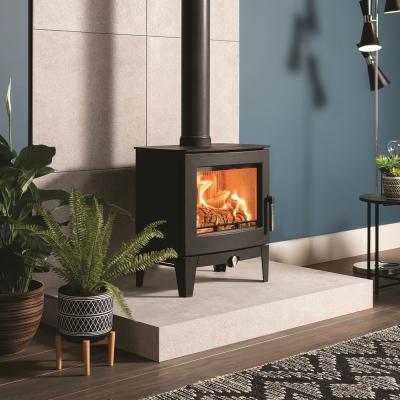
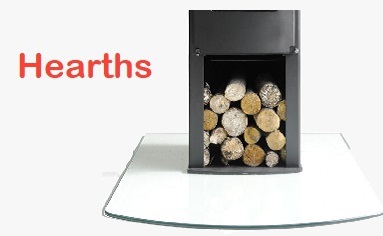
A stove must stand on a non-combustible hearth extending a minimum of 300mm in front & 150mm out from the stove at the sides. If the hearth is on a combustible floor it must be at least 250mm thick. Some stove manufactures have models that have been designed and tested to have a hearth temperature not exceeding 100 degrees centigrade, in this case a 12mm hearth can be used.
Ventilation
Fixed ventilation must be provided when installing any solid fuel stove which has an output higher than 5kws.
Home |
|
 |
|
|
|